
What used to take a team of six engineers six months now takes one person a week. Sometimes a day.
With the massive leaps in agentic coding and frontier LLMs, the traditional moats of software development have evaporated. You no longer need millions in funding to compensate a massive headcount of data scientists, ML engineers, and frontend devs just to get an MVP out the door. Today, the only real limit is your product sense.
I’ve spent my career in data science and applied ML, shipping products across industries that have nothing to do with each other—from the Kansas City Royals front office, to national defense, to sports prediction markets, and currently leading public sector Generative AI research at Unstructured. Working across sports, media, and government taught me that your effectiveness isn’t bound by domain expertise. It’s about translation. The real superpower of applied ML is taking a messy business problem and translating it into a concrete technical solution. That skill transcends the industry. If you can do that, you can build anywhere—and AI just put that ability into overdrive.
Introducing PQ Labs
That observation is why I’m launching PQ Labs.
PQ Labs is the umbrella brand for the projects I’m building across these industries. The goal is simple: do real research, build novel SOTA applications of ML and AI, and ship them as real products. Pure research often misses the strongest signal that something is actually valuable—someone pulling out their wallet to pay for it. I’m not here to write papers. I’m here to ship products with real business models, and I’m using this Substack to document the entire process in public.
Content creation has always felt daunting to me. But in a world where the algorithm runs everything and we all live in echo chambers, doing the work in public and promoting the real exchange of ideas matters more than ever.
Enter StringTheory
For the last few weeks, I’ve been heads-down building the first product coming out of PQ Labs: StringTheory.
Every crime drama or investigative thriller has that scene—the detective standing in front of a map, photos pinned up, red strings crisscrossing to connect people to places, dates, and motives. By creating a network of the players, the bank accounts, and the locations, a follow-the-money investigation reveals the hidden patterns that explain the whole operation.
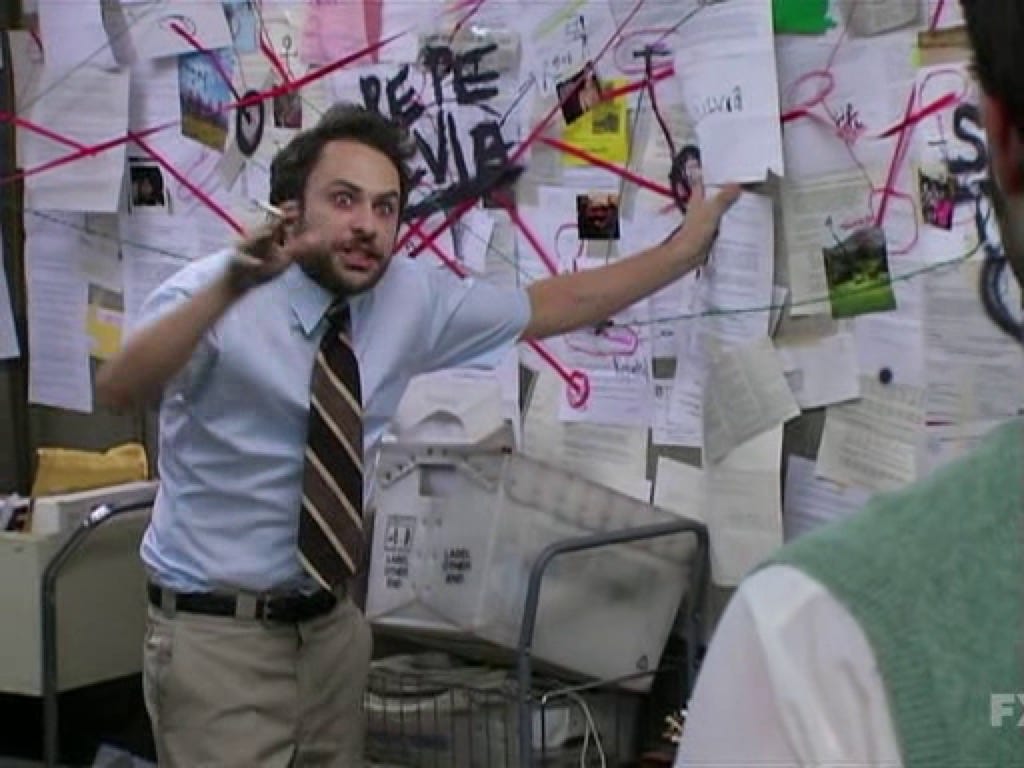
That is exactly what this product is. It’s the digital version of that map, built to track the United States political system.
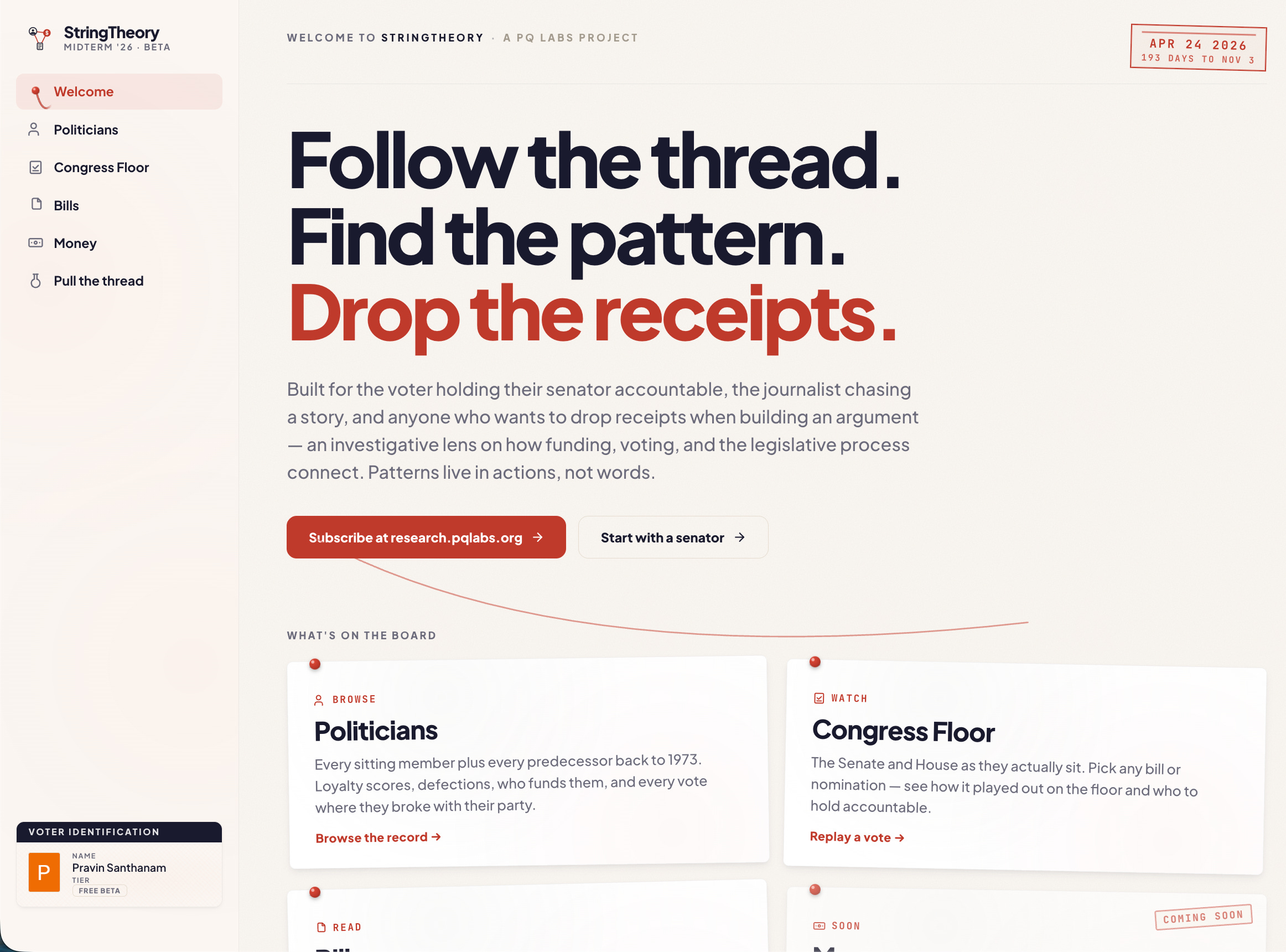
Every politician, bill, donor, and vote is a pin. The strings between them are the connections—who funded whom, who sponsored what, who voted how, who sits on which committee. Pull a thread, and the pattern reveals itself.
Why this, why now
I chose this as the first project because the whole point of building solo right now is velocity. Moving fast is the advantage you have at any startup, and what’s the use of AI tools that let you build a product in a week if you just end up spending the next six months trapped in a slow, miserable enterprise sales cycle? I wanted to build something I could put directly into the public’s hands on day one and see what happens.
More importantly, it’s a tool I desperately wanted to build for myself. I need this to exist.
The state of the political landscape in 2026 is the worst I’ve seen in my lifetime. Good-faith conversation has been crippled by collapsing trust in legacy outlets and a new independent media space dominated by influencers with their own agendas and self-interests. Between “fake news” rhetoric and algorithmic confirmation bias, the public’s understanding of what our elected officials actually do is at an all-time low, including my own.
The thesis is simple: Public trust is at an all-time low. Today, any editorialized content—whether it’s a TikTok, a podcast, a newspaper column, or directly from a politican themselves—is instantly dismissed as propaganda. That reflex kills any chance of a productive discussion about what's actually happening in this country.
Between a genuine passion for the underlying data and my own frustration with this current toxic climate, StringTheory was the perfect starting line. It pushes back against the noise. It is grounded entirely in measurable actions pulled from primary sources the government is legally obligated to publish. I can’t fix journalism or the algorithm, nor do I know how, but I can build a tool that helps find signal in the noise through data-driven insights that are not opinions, but puzzle pieces that help you reason objectively about your own views.
Under the hood, this system is a Knowledge Graph, which is structured in a way that maintains the vital relationships between entities, legislation and funding required to connect the dots.
Which donors funded the sponsor of this bill?
Which committee chairs hold positions that correlate with their campaign funding?
How have a senator’s views evolved over time, told through their voting history and PAC donations?
Have you ever wondered any of these things? I have. And right now there is no easy way to understand these patterns and get clear answers on what has happened in the past or predicting what will happen in the future.
Who is the target user
The Knowledge-Hungry Voter: You want to understand your state’s delegation and see the source material for yourself before deciding what you think.
The Investigative Journalist: You need to trace connections across systems that weren’t designed to talk to each other, to conduct a data-driven investigation and discover why things happen the way that they do.
The Social Media Comment Warrior: You want objective, shareable receipts to drop into an argument. Real primary-source evidence that holds up under scrutiny, not my facts vs. your facts.
The Tenets
You can’t build in a space this noisy without a North Star. These four tenets are the absolute foundation of StringTheory. They are a public commitment to staying on mission, and every single feature shipped will answer to them:
Actions, not rhetoric. Votes cast, checks cashed, bills signed. What someone does is the signal; what they say is mostly noise.
Federally mandated sources. We rely entirely on data the government is legally obligated to publish. When that data is messy, delayed, or incomplete, we will be radically candid about the gaps. But the rule remains: no receipts, no post.
The full tally, not the half. Every cosponsor, every donor, every defector. Not just the slice that fits a narrative.
Facts, not verdicts. Quantitative evidence to build your own case on. Not judge, jury, or executioner.
Where this goes
What launches next Friday is the MVP—useful on day one. But the long-term vision is to build complex analytics on top of this foundation, including vote prediction with graph neural networks, natural-language Q&A over the graph, and coalition detection to surface the hidden voting blocs that actually pass or kill legislation.
As the Knowledge Graph foundation becomes more solid, these won’t be just ideas on a whiteboard. We’ll tackle them one by one—taking a real use case, translating it into a technical model, and showing exactly how it gets built.
The Rollout
Monday, April 27: Product walkthrough with screenshots.
Friday, May 1: Launch day. StringTheory goes public, I’ll drop the domain, and a tutorial video on some of the key features.
Ongoing: Fridays are for talking product, tech, and tools. Mondays are for showcasing the tool and its features by investigating historical events and analyzing what’s going on in US politics today.
If you’re building something ambitious by yourself, the Friday posts are for you.
If you’re open to consuming political content and analysis in a completely different way than editorialized content, the Monday posts are for you.
Thanks for being here on day one.
— Pravin
I am also building something ambitious so the Friday newsletters will be for me then 😜
I can't wait to see how you're using graphs and see what the heck is going on through StringTheory.