
Back in May, I said campaign finance was coming. It took longer than I expected.
The first StringTheory pages followed what politicians do: the bills they sponsor, the votes they cast, the committees they sit on. The Funding section adds the other half of that corkboard. Who gives them money? Who spends around their races? How does that connect to what happens in Congress?
The hard part is that the system is complicated, and that complexity can be used to hide where the money started. Dollars pass through nonprofits, PACs, and other committees, leaving records under different names and on different schedules. You can see the group writing the check while the people who supplied the money stay hidden.
Why following the money gets messy
In Hasan Minhaj’s conversation with Issue One’s Michael Beckel, they walk through a frustrating distinction: a Super PAC can disclose the nonprofit that funded it without revealing the people who funded that nonprofit. There is a name on the filing. That does not necessarily mean you have reached the source.
“Mega-donor,” “Super PAC,” and “dark money” answer different questions. The same chain of money can involve all three.
Mega-donors are the people writing large checks. That describes the giver, not the route the money takes. A corporate treasury is another source; it is different from an executive giving personally.
Super PACs are spending vehicles. They raise money from disclosed contributors and spend independently of campaigns. Those contributors can be individuals, companies, or other organizations.
Dark money describes a visibility problem. Some politically active nonprofits, including 501(c)(4) groups, do not generally disclose their underlying donors publicly. We may see their payment to a Super PAC while the previous step remains unknown.
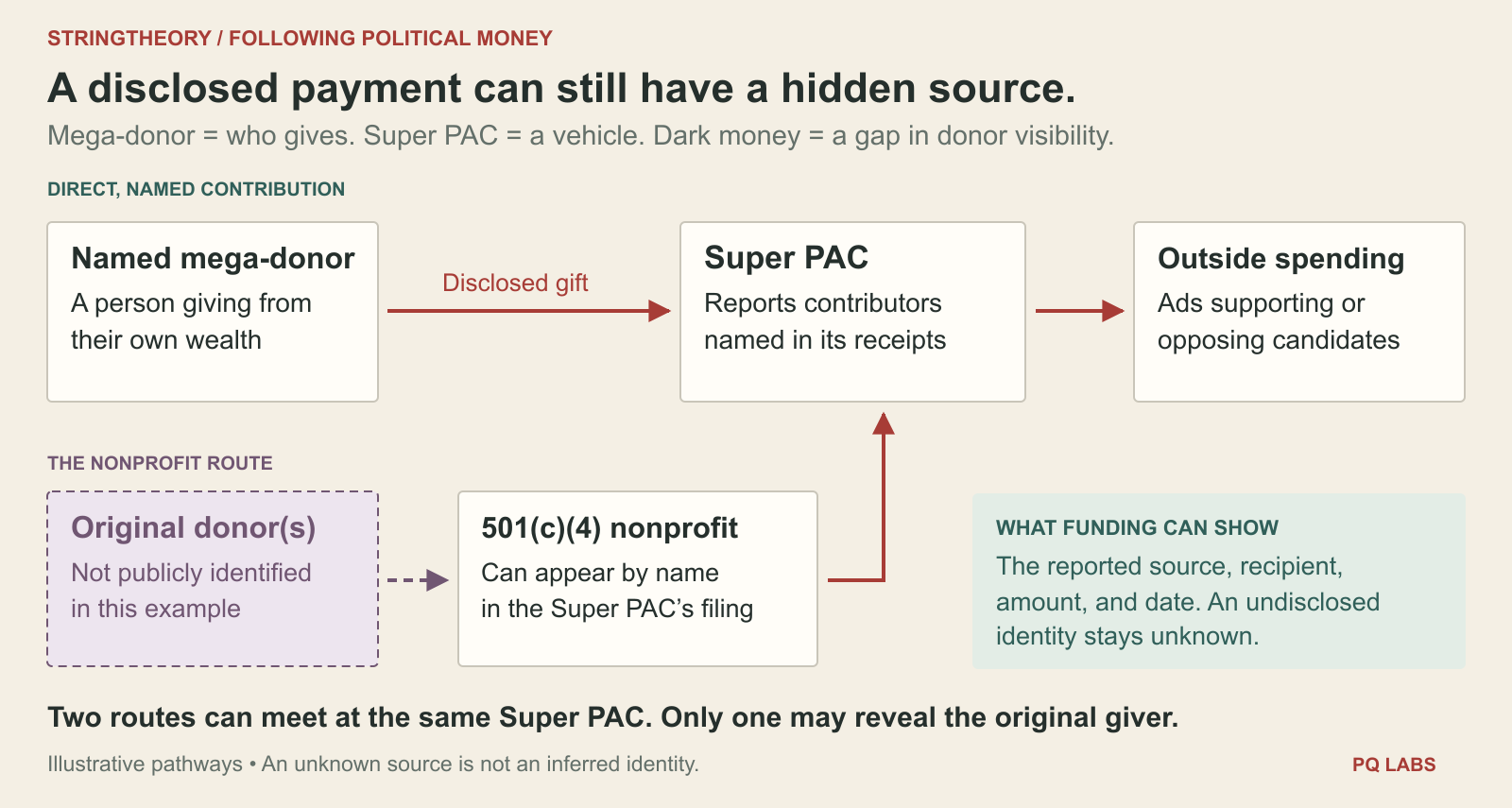
These categories overlap. The Super PAC can be visible while part of its funding trail remains dark. Illustrative paths, not a claim about a particular donor.
That is why the Contributors tab separates individuals such as Elon Musk from nonprofits such as One Nation, even when both appear in SLF PAC’s receipts.
The money changes form. Campaign donations, committee transfers and outside ads leave different records. Bundled gifts and attributed shares can describe the same dollars more than once.
The filings arrive on different clocks. Regular reports, amendments and rapid spending notices can overlap. An ad can run before its funding becomes clear.
A few highlights from the app
Choose Funding in the sidebar to follow along. You’ll need an account. We’ll start with the big picture in Explore, then follow a donor, a race and a connection to Congress.
Screenshots are from October 21, 2026; figures will change as filings arrive.
1. Explore: find a starting point
The Explore tab gives you the big picture. Who is sitting on cash, and who is already spending it? Switch between the Nov Cash (“Dry Powder”) and Ads Spent So Far views to separate reserves from active ad spending. A big fundraising total does not necessarily mean a group is spending the most.
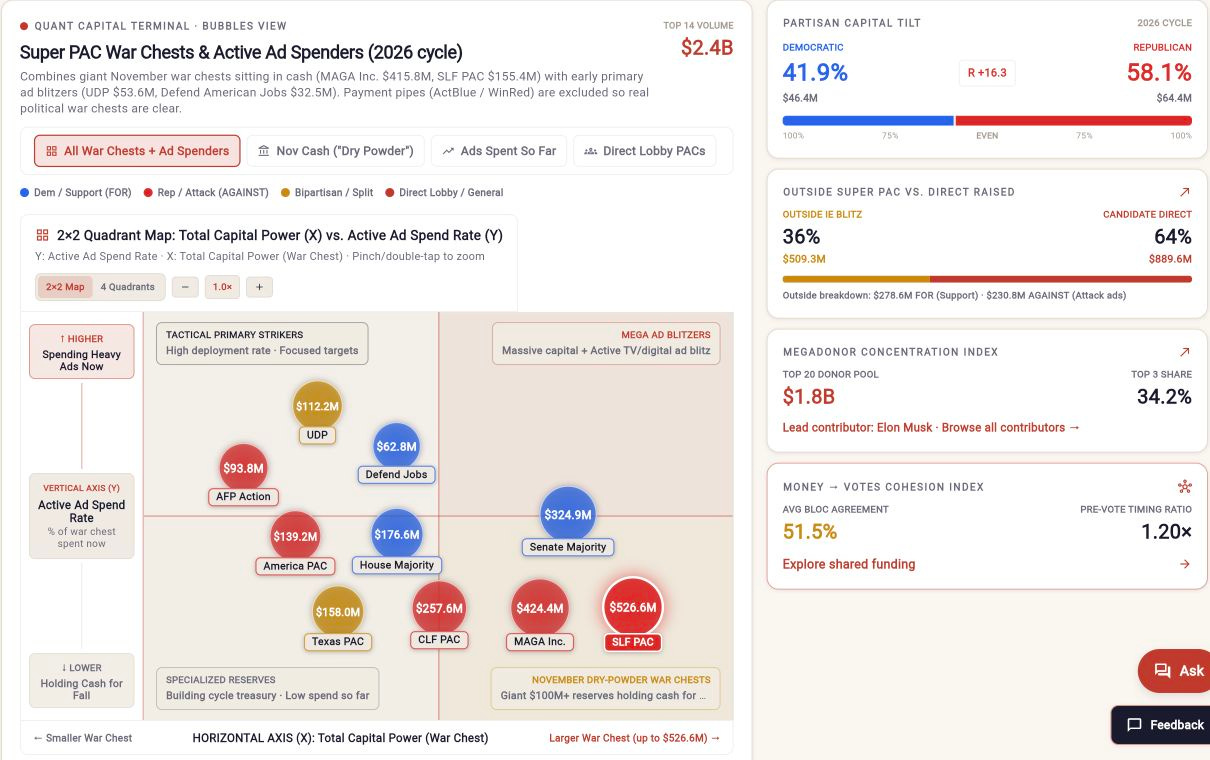
From here, the Contributors tab follows people and organizations; the Committees tab compares the groups receiving and spending money.
2. Where did Elon Musk’s money go?
Open Elon Musk’s contributor profile, then the Recipients tab. This snapshot shows $168 million reported for SLF PAC (Senate Leadership Fund) and $102.9 million for America PAC. You can see the recipients together, then open any one of them.
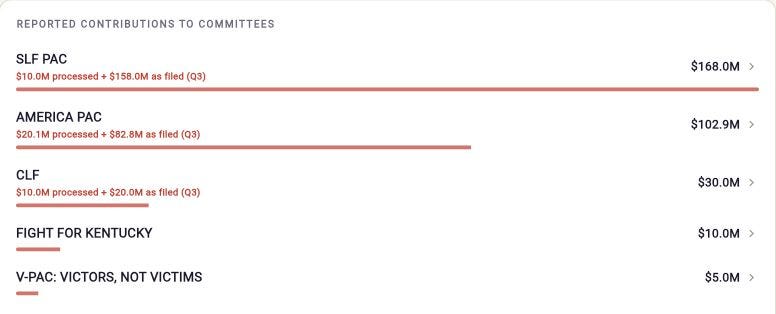
The labels separate processed receipts from newer, as-filed reports.
To follow a transfer onward to another committee, open the Money path tab on SLF PAC’s committee profile. Each reported transfer has a source record to inspect.
3. Break down midterm campaign financing
The Races tab puts campaign fundraising beside outside support and opposition. Open John Cornyn’s politician profile, then his Funding tab: $8.6 million raised by his campaign, with $6.8 million in outside support and $4.3 million in outside opposition. The outside money never enters his campaign account.
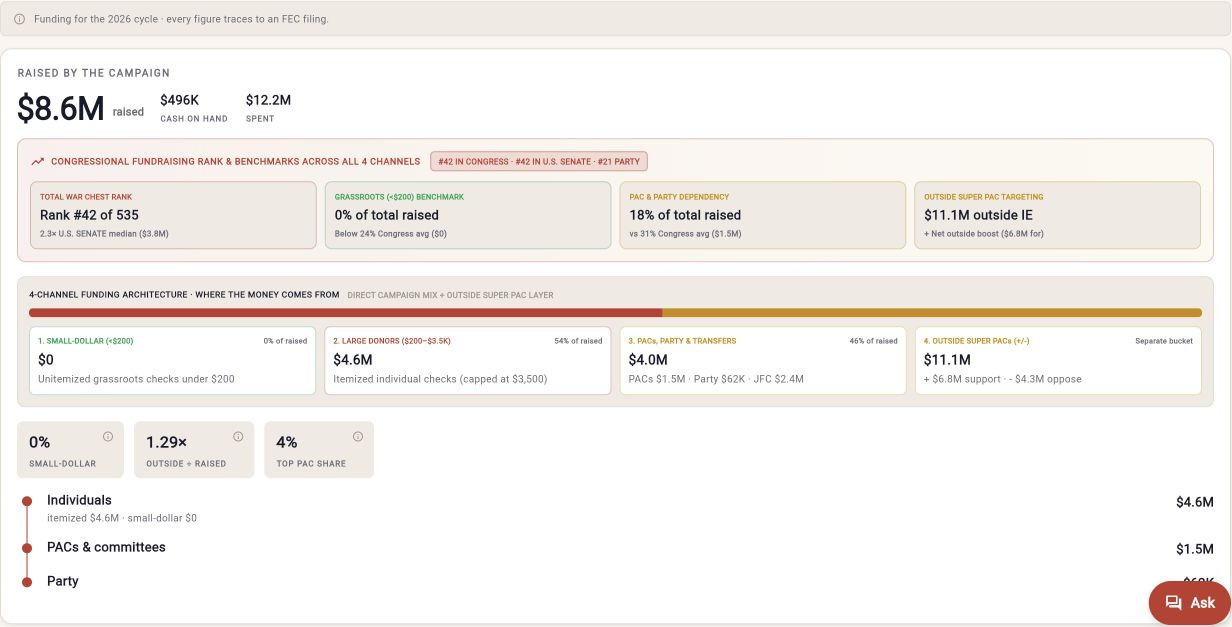
Within that Funding tab, the “Where it went” section shows reported payees. The 2026 election cycle covers 2025–2026.
4. Put AIPAC’s funding beside the actual vote
This is the connection I most wanted to make: once you know which lawmakers a group backs, what do those lawmakers do?
The Shared funding tab follows those connections into Congress. AIPAC PAC gives directly to campaigns; United Democracy Project spends independently. Those are separate paths.
In AIPAC’s money-to-vote graph, all 20 senators in the connected group voted no; the full Senate split 24 yes to 73 no. The question was whether to bring a resolution to block a proposed arms sale to Israel out of committee.
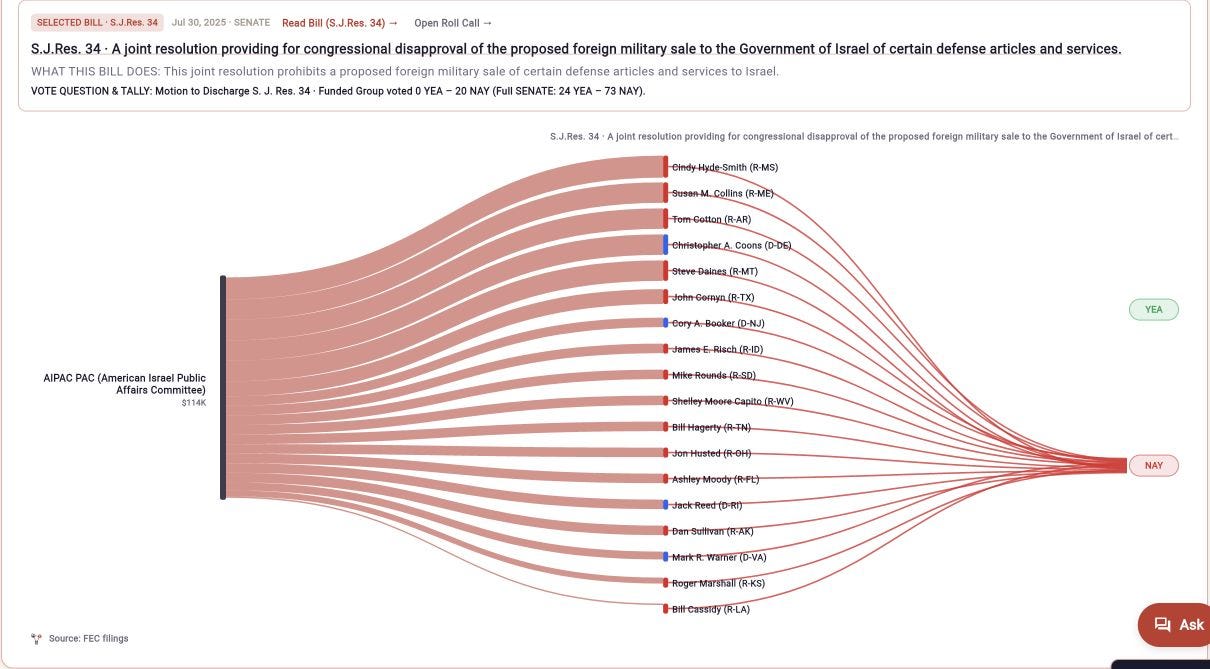
A connection worth investigating—not proof that a donation caused a vote. The bill, vote question and timing are there to check.
The Topics tab on AIPAC’s committee profile goes further into the policy areas and underlying bills those lawmakers work on.
There is a lot more to explore
These are a few highlights, and I know the experience can still feel like a lot. I am working through a redesign and continually improving how we present the connections, so useful insights are easier to find and digest. You should not need to learn the entire campaign-finance system to ask a good question.
I’ll get into the technical details in the upcoming ML series: how we match donor records, build the models, and design the agents behind the app.
More posts and product updates are coming over the next few weeks as we head into the midterms, including dropping iOS app, predictive insights, and a simpler experience. Stay tuned.
Spooky szn 🎃
— Pravin
Explore StringTheory: Web app · Android app