
I was watching My MAGA Life, an ARTE documentary about Trump’s second term, when a segment about Washington’s buildings caught my attention. It features Justin Shubow, president of the National Civic Art Society, who helped draft the administration’s architecture order.
The order, Making Federal Architecture Beautiful Again, favors traditional and classical styles for covered federal buildings, with classical architecture the default in Washington, D.C.
Naturally, I wanted to know what else was in there.
I went through the 292 second-term executive orders in StringTheory. Some concern fundamental rights. Others concern nuclear reactors, Bitcoin, or whether your drink comes with a paper straw. The range is impressive.
An unusual recipe for an unproductive Congress
Executive orders let a president direct the executive branch without passing a new law through Congress, using authority granted by the Constitution or existing legislation.
StringTheory’s enactment records put the 119th Congress (2025–2027) at 138 public laws through November 9, 2026: the second-fewest among 20 Congresses since 1987, comparing each through November 9 of its second year. Only the 118th had fewer. Pew’s October analysis found the same ranking at an earlier cutoff.
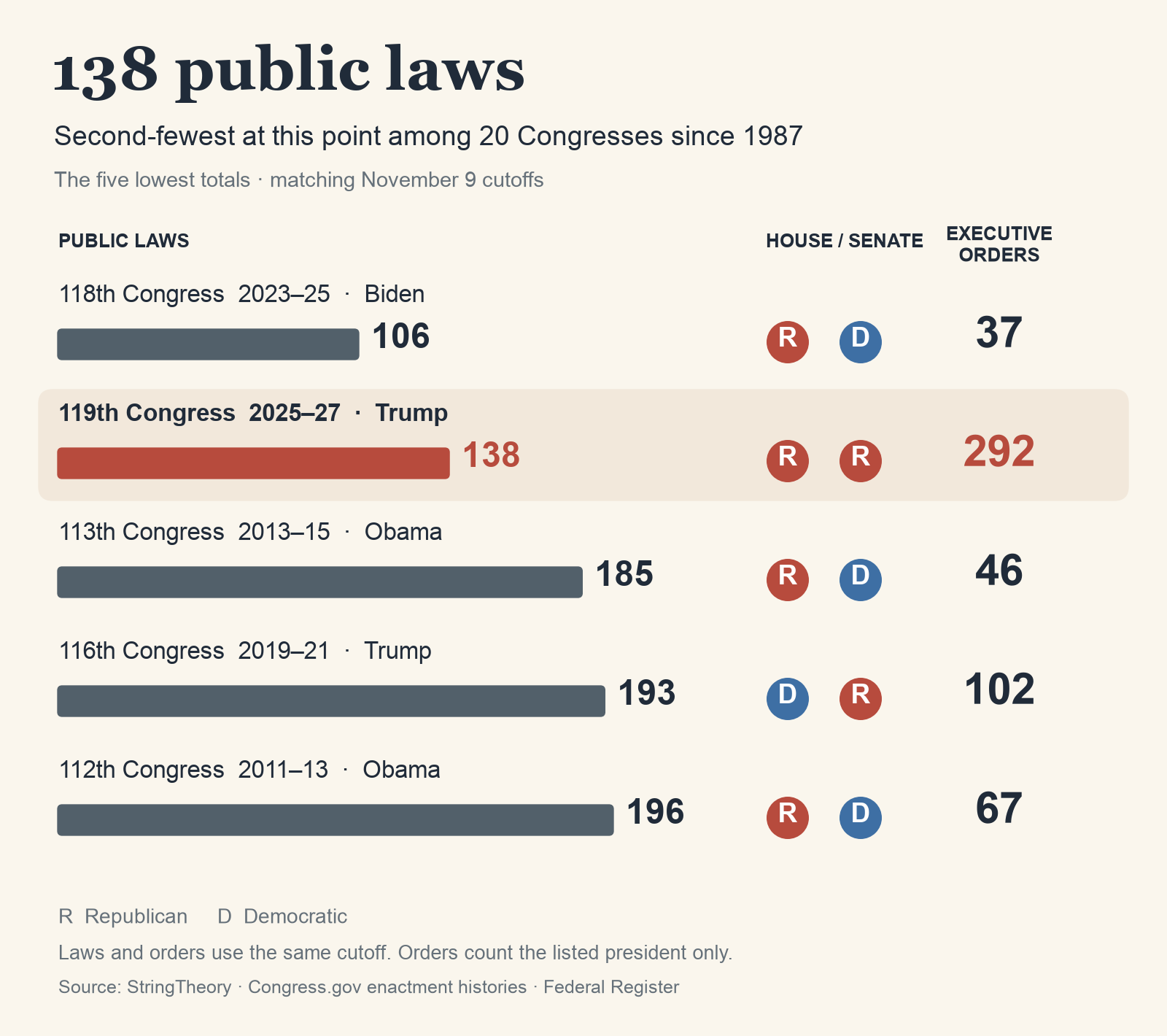
Counts through November 9 of each Congress’s second year. Executive orders count only those signed by the listed president during that Congress, through the same date. R = Republican majority; D = Democratic majority
Of the five Congresses with the fewest public laws in this comparison, only the current Congress had the president’s party controlling both chambers. Historical party control
Both chambers must approve the same text. An opposition-led chamber gives the president’s opponents another place to stop legislation. This Congress has no such partisan split. Republicans’ current 53 Senate seats also fall short of the 60 generally needed to end debate on contested legislation. Final passage usually needs a majority; reconciliation avoids the 60-vote hurdle for certain tax and spending measures. How the two chambers agree · Senate voting rules · Reconciliation
Trump’s 292 executive orders, through the latest published order signed October 22, already exceed the 220 from his first term, Biden’s 162 over four years, and Obama’s 276 over eight. Executive-order counts.
To me, the combination of so little legislation and so many executive orders signals a shift in the center of policymaking—from our elected representatives in Congress toward a president acting more unilaterally. That puts greater weight on the courts to enforce the limits of presidential power.
Here are my five picks in each category, grouping related orders where the same idea keeps coming back.
Five that worry me
1 Deciding who is born an American
The January 2025 birthright-citizenship order sought to deny citizenship documentation to certain U.S.-born children based on their parents’ immigration status. The Supreme Court struck it down in June 2026.
Trump returned with EO 14418 on August 6, targeting categories of children when neither parent is a citizen, including children born through certain commercial surrogacy arrangements and children of foreign government employees. A Maryland judge blocked that follow-up for a certified class in September, and it faces a further class-action challenge.
This worries me because the government is attempting to redraw who belongs to the country at birth. The effort continued after the first order failed.
2 Putting the Postal Service between voters and their ballots
People returning ballots by mail would have to appear on state-specific USPS lists under EO 14399 (March 31, 2026). The order also directs federal citizenship lists.
A missing or mismatched record could affect a person’s access to a ballot. This follows the 2025 election order, which included documentary proof of citizenship for the federal registration form.
Courts blocked implementation of the resulting USPS rule for the 2026 election; the Supreme Court declined to lift an injunction on September 14. These restrictions did not simply become the rules for last week’s election.
3 Making a law firm a presidential target
EO 14230, signed March 6, 2025, targeted Perkins Coie with suspended security clearances, restrictions on access to federal buildings, and reviews of government contracts involving the firm or its clients. Its opening explicitly attacked the firm’s work for Hillary Clinton and on election cases.
Similar orders targeted Jenner & Block, WilmerHale, and Susman Godfrey. The concern reaches anyone who might need a lawyer to challenge the government: would a firm hesitate to represent you if doing so could endanger its other business?
A judge declared the Perkins Coie order unconstitutional and permanently barred its enforcement. The government appealed; the firms argued that appeal in May 2026.
4 Bringing independent regulators under White House control
Independent regulators must send significant proposed and final rules through White House review under EO 14215 (February 18, 2025). The White House budget office also gains oversight, and executive-branch employees must follow the president’s and attorney general’s interpretation of the law.
The Securities and Exchange Commission (SEC), which regulates financial markets, is covered. A significant rule about what public companies must tell investors would therefore face White House review before publication.
The Federal Reserve’s work on interest rates and other monetary policy is exempt. Its supervision and regulation of banks are covered.
The administration calls this accountability. My concern is how much room agencies such as the SEC have to protect investors when doing so conflicts with a president’s political priorities.
5 Connecting government data about you
EO 14243, signed March 20, 2025, directs broad access to unclassified agency records for designated officials pursuing anti-fraud priorities. It also calls for access to data from federally funded state programs and specifically names unemployment records.
I spend a lot of time connecting government data. The privacy stakes rise sharply when those connections involve people’s benefit and payment records.
The order repeatedly limits its instructions to what the law permits. The questions I want answered are who gets access, what they can combine, and what prevents the resulting information from being used for something else.
Five I find interesting
1 The government gets a Bitcoin reserve
A Strategic Bitcoin Reserve, established by EO 14233 (March 6, 2025), is to hold qualifying Bitcoin the government obtained through forfeiture proceedings, subject to legal exceptions such as returning assets to crime victims.
The order also directs officials to develop budget-neutral strategies for acquiring more. Other forfeited digital assets go into a separate stockpile.
The order’s argument is that Bitcoin’s limited supply makes it worth keeping as a reserve. What interests me is the decision to keep coins recovered in law enforcement as a long-term national asset, whose value rises or falls with Bitcoin’s price.
2 A strategy for a much larger nuclear industry
The four nuclear orders signed on May 23, 2025, aim to make nuclear power a much larger part of America’s electricity supply. The headline goal in EO 14300 is to expand capacity from roughly 100 gigawatts in 2024 to 400 by 2050.
Each order tackles a different part of getting there:
Speed up licensing. EO 14300 directs the Nuclear Regulatory Commission to establish an 18-month maximum for decisions on new reactor applications and an expedited path for designs already safely tested by the Energy or Defense departments. That is a licensing deadline, not a promise to build a plant in 18 months.
Test new designs faster. The reactor-testing order, EO 14301, directs faster testing under Department of Energy authority, including a pilot program outside the national laboratories.
Create places to deploy them. The deployment order, EO 14299, directs reactor deployment at military installations and Energy Department sites, including power for AI infrastructure. It also directs federal support for American nuclear exports.
Build the industry behind the plants. The industrial-base order, EO 14302, directs support for domestic nuclear fuel production, worker training, plant restarts, and upgrades. Its targets include having 10 new large reactors under construction by 2030.
Taken together, I read this as a bid to rebuild a whole American industry: make nuclear easier to test, approve, fuel, finance, and sell, at home and abroad. It backs both large plants and newer small reactors. AI demand and national security supply much of the argument for moving faster.
The question I’d watch is whether that speed translates into affordable, reliable power while preserving credible safety review. EO 14300 also directs reconsideration of radiation standards and streamlining of public hearings. Those changes deserve scrutiny alongside the construction targets.
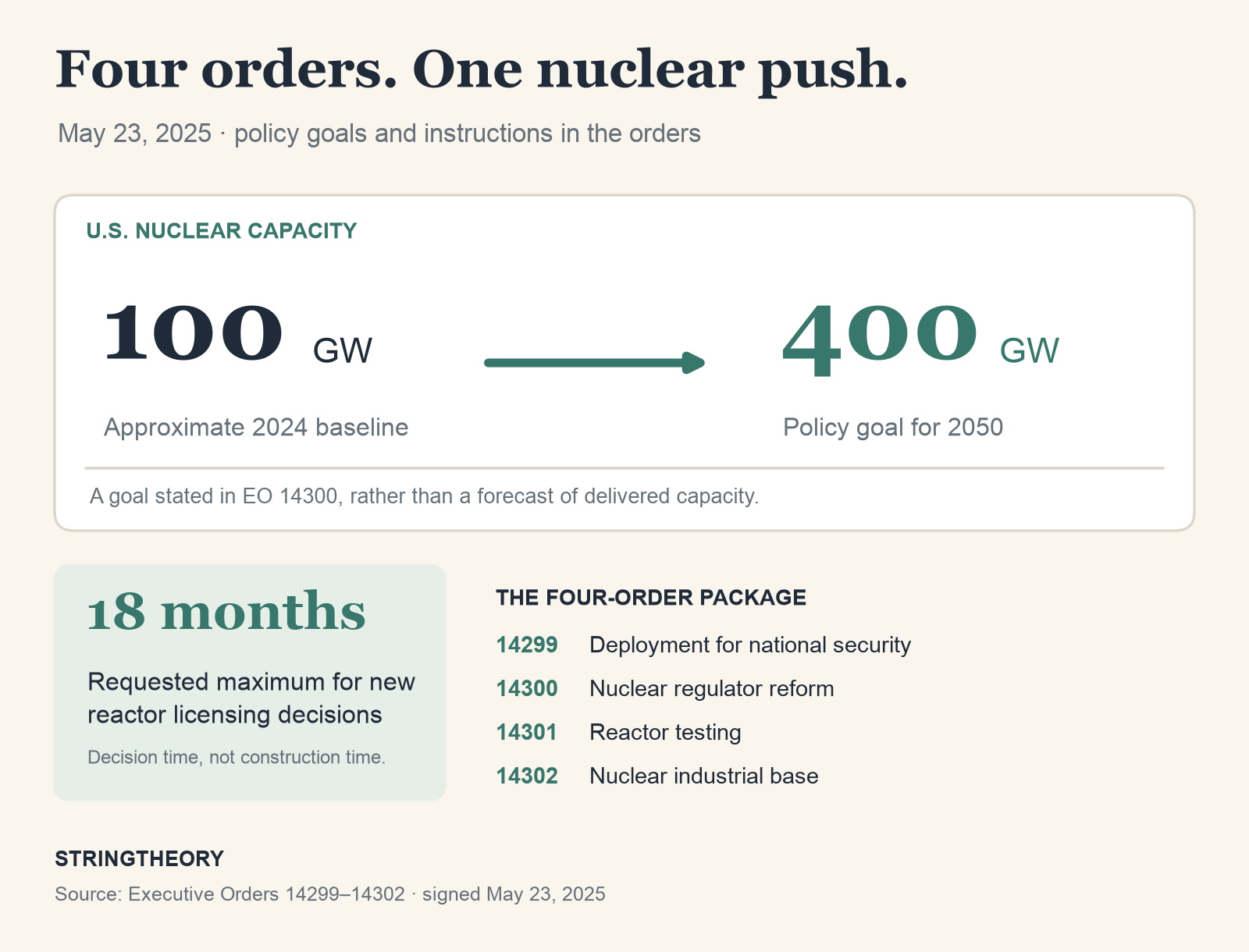
The targets and instructions in the May 23 nuclear-order package. The 2050 capacity figure is a policy goal; the licensing deadline concerns a decision, rather than construction time.
3 Bringing back supersonic flight over land
Trump directed the FAA to replace the prohibition on civilian supersonic flight over land with a framework based on noise standards in EO 14304 (June 6, 2025). It also directs research and international coordination.
Check out Concorde, the British-French passenger jet that operated commercially from 1976 to 2003. It cruised at roughly twice the speed of sound and could fly from London to New York in less than three and a half hours.
The connection to this order is the sonic boom: the loud shockwave people on the ground hear when an aircraft flies faster than sound. NASA’s history explains how overland restrictions limited Concorde’s routes and commercial prospects. Concorde showed the time savings were possible. The order’s bet is that quieter aircraft and noise-based rules can open more routes, with the practical test being how much noise the people underneath them would have to live with.
4 Accelerating psychedelic treatments
EO 14401, signed April 18, 2026, prioritizes review of certain psychedelic drugs, including research involving ibogaine compounds, and directs at least $50 million from existing funds toward federal-state collaboration.
It also calls for regulated access pathways and coordination among health agencies and Veterans Affairs. The focus is research and potential treatments for serious mental illness, with drug approvals still subject to the relevant requirements.
Joe Rogan was in the Oval Office for the signing. In the signing remarks, he said he’d texted Trump information about ibogaine and recounted Trump’s reply: “Sounds great. Do you want FDA approval? Let’s do it.” Trump confirmed Rogan had contacted him and said he’d asked health officials to check it out.
That is quite a route from podcast to presidential desk. Semafor reported that advocates had been pushing for months, and FDA Commissioner Marty Makary later said ibogaine was already under consideration before Rogan’s text.
The December 2025 marijuana-research order fits the same pattern: expanding research into possible medical uses.
5 Taking on institutional homebuyers
Large institutional homebuyers are the target of EO 14376 (January 20, 2026). It directs agencies to restrict federal sales and financing that help these investors acquire single-family homes available to owner-occupants.
There are exceptions, including for purpose-built rental communities. The order also directs antitrust reviews and asks for a legislative proposal to put the broader policy into law.
The mechanism is what caught my attention: using the government’s role in housing finance to change who gets to compete for a home. Whether that meaningfully helps buyers depends on the scope and execution.
Five that made me look twice
1 The president has architectural preferences
Back to the order that started this. EO 14344, signed August 28, 2025, prefers traditional and classical architecture for covered federal buildings. In D.C., classical architecture becomes the default, with exceptions. Certain departures require advance notice to the president.
It includes actual definitions of Brutalist and Deconstructivist architecture. Its definition of the “general public” excludes architects, engineers, art critics, and several other design professions.
For the purposes of deciding what the public likes in a building, knowing too much about buildings apparently puts you in a different category.
2 A national strategy for paper straws
Federal agencies were told to stop buying and providing paper straws. EO 14208 (February 10, 2025) also gave officials 45 days to produce a “National Strategy to End the Use of Paper Straws.”
There is a separate showerhead order, directing repeal of a regulatory definition. There is a whole category here devoted to everyday annoyances.
A paper straw falling apart halfway through a drink is annoying. I had underestimated how far up the chain you could escalate the complaint.
3 The Presidential Fitness Test returns
Trump ordered the return of the Presidential Fitness Test in EO 14327 (July 31, 2025). The order directs the sports and fitness council to recommend how to bring it back, with appropriate improvements.
The test is meant to become the main assessment for a Presidential Fitness Award, alongside school-based programs rewarding excellence in PE. The unusual part is the national-security framing: the order treats poor youth fitness as a threat to the future workforce and military readiness.
4 The federal rebranding department
The Interior Department was directed to rename Lake Ontario “Lake America” in federal records and government usage by EO 14422 (August 27, 2026). This follows Gulf of America and the restoration of Mount McKinley. The president’s pen does not extend to Canadian maps.
Then EO 14434, signed September 29, 2026, directs agencies to replace “Artificial Intelligence” and “AI” with “Super Intelligence” and “SI” in covered official communications, as far as the law permits. For now, the new label uses the existing statutory definition of artificial intelligence.
As someone building an AI app, I appreciate an upgrade that can be accomplished with Find and Replace.
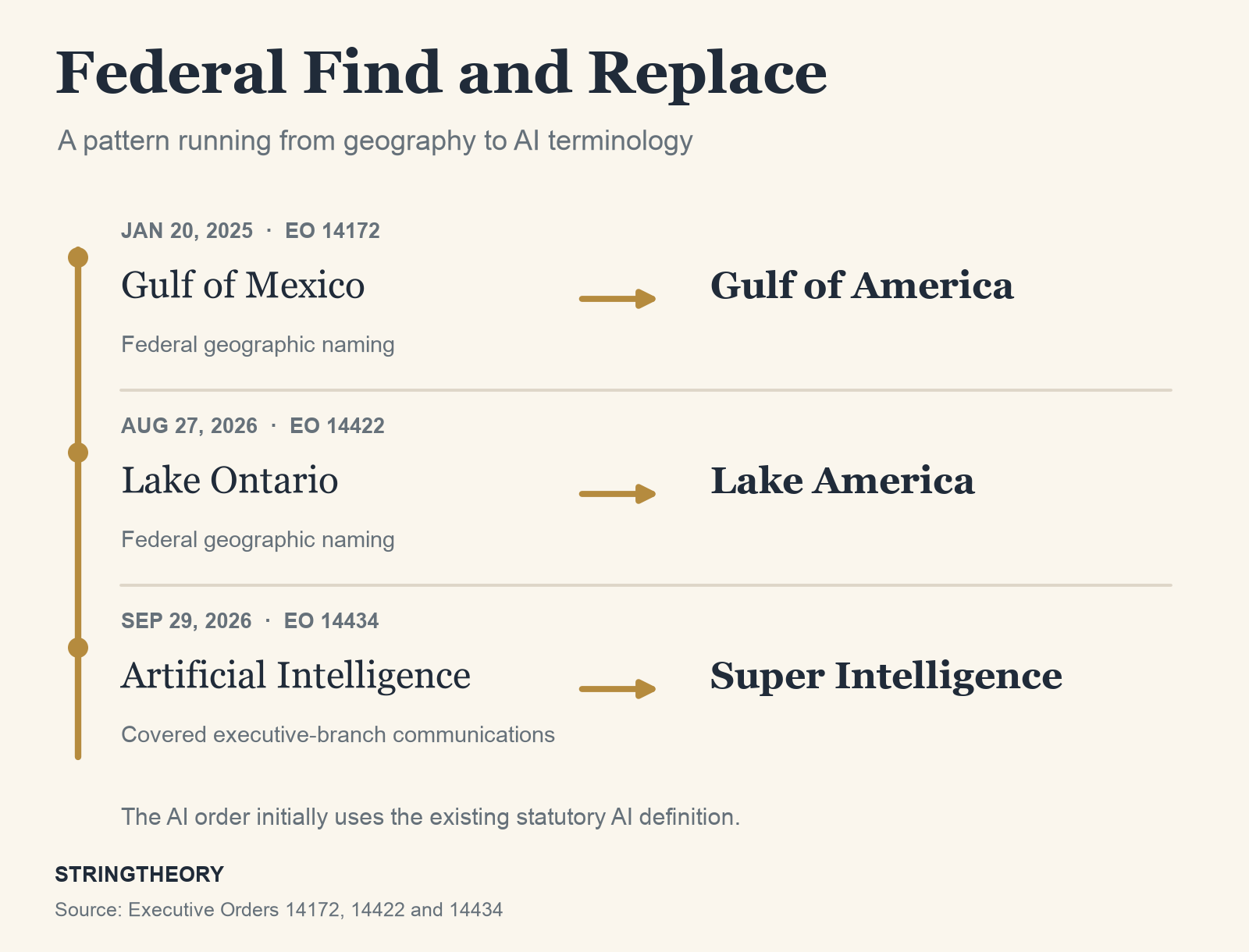
Three examples of federal renaming directives. The AI order initially uses the existing statutory definition for its new terminology.
5 Turning the capital into a racetrack
Trump gave the Interior and Transportation departments 14 days to designate an IndyCar street-racing route through Washington, D.C., for the Freedom 250 Grand Prix in EO 14381 (January 30, 2026).
The order also directed agencies to expedite permits, coordinate road maintenance, and enable permitted aerial photography.
The race went ahead on August 23, 2026. Kyle Kirkwood won on a 1.7-mile temporary circuit around the National Mall. Trump and Melania took a pre-race lap in the presidential limousine, and Trump waved the green flag to start the race.
You can browse these and the rest on StringTheory’s Executive orders page, search by topic or order number, and open the source text yourself.
In Closing
Trump’s second-term executive orders have covered a lot of ground. The current Congress and its predecessor have passed the fewest public laws in our comparison going back to 1987. I think it’s fair to ask how much partisanship is holding back lawmaking—and how much policymaking we want to leave to the president.
Which one would you put on the list? I’m especially interested in the ones that got less attention than the headline orders.
Thanks for reading,
— Pravin
Explore StringTheory: Web app · Android app